3.2 Indexing conventions: 0-based and 1-based
Explanation
An index specifies the position of an element. Different languages use different conventions. Rust, C, C++, and Python use 0-based indexing. MATLAB and Fortran use 1-based indexing.
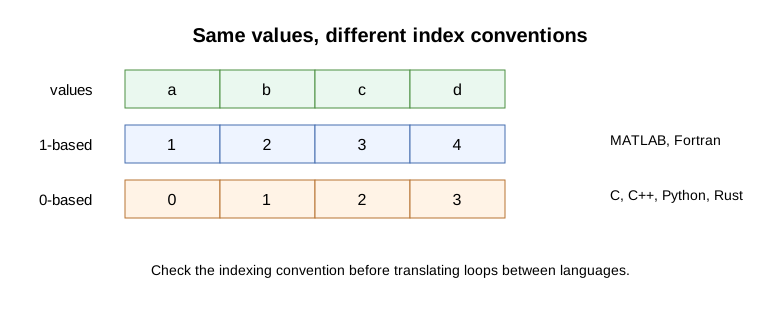
This is a common source of off-by-one errors. If an AI agent gives a MATLAB or Fortran example, you must check index conventions before translating it to Rust.
let xs = [10, 20, 30];
let first = xs[0]; // 10 in Rust
Things to look up
- 0-based indexing
- 1-based indexing
- Off-by-one error
- Array slicing
- Rust array indexing
- MATLAB array indexing
- Fortran array indexing
Exercise
For the values [10, 20, 30, 40, 50], answer:
- In 1-based indexing, what are the indices of
20and50? - In 0-based indexing, what are the indices of
20and50? - In Rust, how would you refer to the first element?
- Why can copying loop bounds from MATLAB or Fortran to Rust be wrong?
Notes for the exercise
- Distinguish the value from the index.
- Check the first index used by the language.
- Watch both start and end points of ranges.
- If AI translates code between languages, inspect every index and loop bound.