4.1 Stack, heap, and references
Explanation
This page belongs to the performance and systems model. On a first pass, you may read the basic memory-layout material and then continue to validation, returning here when aliasing or memory behavior becomes important.
Stack and heap are simplified words for different kinds of memory use. You do not need to memorize implementation details here. The important idea is that small local values and call frames are different from large or dynamically created objects such as arrays.
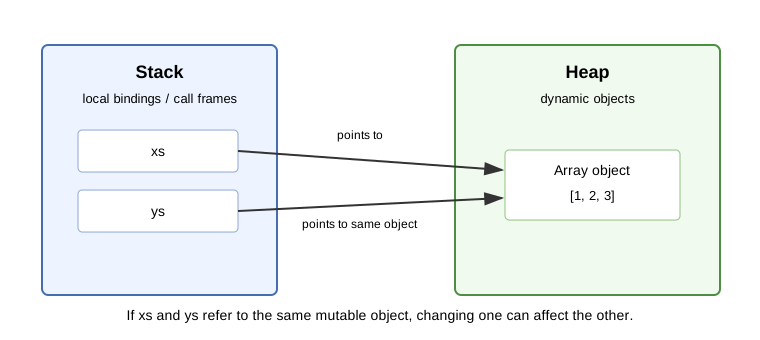
In Rust, a Vec<f64> value contains small metadata such as pointer, length, and capacity. That metadata is held by the local variable, while the vector’s element buffer is allocated on the heap. Ownership controls who is responsible for that buffer. References such as &[f64] and &mut [f64] let functions borrow data without taking ownership.
fn sum_values(xs: &[f64]) -> f64 {
    xs.iter().sum()
}

let xs = vec![1.0, 2.0, 3.0];
let total = sum_values(&xs);
This function can read the heap buffer through a shared reference, but it does not own the vector and cannot mutate it. A function that needs to modify the values should take &mut [f64] so the mutation is explicit at the function boundary.
Things to look up
- Stack memory
- Heap memory
- Reference
- Ownership
- Borrowing
Vec<f64>- Slice
- Aliasing
- Mutable object
Exercise
For the Rust code above, draw the local variables and the heap buffer. Which data are part of the Vec<f64> value, and which data live in the element buffer? What does &xs allow sum_values to do?
Then write a function signature for a function that scales a vector in place. Should it take Vec<f64>, &[f64], or &mut [f64]?
Notes for the exercise
- Distinguish ownership from borrowing.
- Distinguish the
Vec<f64>metadata from the heap buffer. - Use
&[f64]when a function only reads 1D numerical data. - Use
&mut [f64]when a function modifies 1D numerical data in place. - Explain why hidden mutable sharing can make scientific code hard to test.