4.2 Processes and threads
Explanation
This page belongs to the performance and systems model. On a first pass, you may read the basic memory-layout material and then continue to validation, returning here when parallel execution becomes important.
A process is a running program with its own memory space. A thread is an execution path inside a process. Threads in the same process usually share memory, while different processes usually do not share memory unless data are explicitly exchanged.
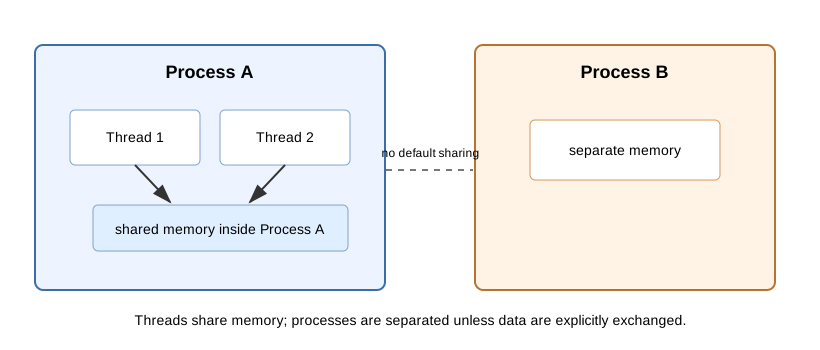
This matters for parallel scientific computing. Threads can communicate through shared arrays, but this also means they can accidentally write the same data at the same time. Processes are more isolated, but moving data between them has a cost.
When you run cargo test, cargo run, or a compiled binary, the operating system starts a process. A numerical program may also create worker threads to split independent simulations, matrix operations, or parameter sweeps. In Rust, safe shared mutation across threads must be made explicit through the type system and synchronization tools.
Things to look up
- Process
- Thread
- Shared memory
- Race condition
- Parallel computing
cargo runcargo test- Numerical simulation
Exercise
Compare two ways to run four independent simulations:
- four separate commands such as
cargo run --bin simulate -- --seed N, - four threads inside one Rust process.
For each approach, list one advantage and one possible problem.
Notes for the exercise
- State whether memory is shared or separated.
- Mention the cost of moving or copying data.
- Mention race conditions for shared-memory code.
- Do not assume parallel code is automatically faster or more reproducible.
- State how you would save each simulation’s result so that outputs do not overwrite each other.