3.3 Multidimensional arrays and memory layout
Explanation
A multidimensional array has a shape, such as 2 x 3. The same mathematical shape must still be stored in one-dimensional computer memory. The order used for storage is called memory layout.
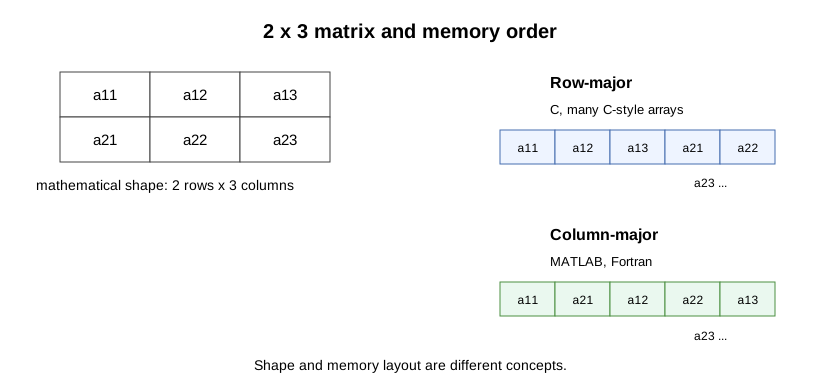
Shape and memory layout are different concepts. A tensor also has metadata that describes how indices map to the owned data buffer. This metadata includes the shape and may include strides. A stride says how far to move in the underlying buffer when one index changes by one.
MATLAB and Fortran use column-major layout. C and many C-style arrays use row-major layout. Rust itself does not have one built-in multidimensional array type. In this course, the standard Rust path for 2D and higher numerical arrays is a tenferro typed tensor, currently tenferro_tensor::TypedTensor, unless an exercise explicitly asks for a flat-buffer implementation. ndarray is also common in the Rust ecosystem.
Nested vectors such as Vec<Vec<f64>> are a poor default for numerical arrays: rows may be stored separately, lengths can differ, and the layout is not one simple contiguous tensor buffer.
For an N-dimensional array written as A[i1, i2, ..., iN], column-major layout makes the leftmost index i1 change fastest in contiguous memory. Row-major layout makes the rightmost index iN change fastest.
This matters for performance because memory access order affects cache locality.
Things to look up
- Shape
- Stride
- Row-major layout
- Column-major layout
- Tensor metadata
- Contiguous buffer
tenferro_tensor::TypedTensorndarray- Fastest-varying index
- Cache locality
- Loop order
Exercise
For a 2 x 3 matrix with entries a11, a12, a13 on the first row and a21, a22, a23 on the second row:
- Write the row-major memory order.
- Write the column-major memory order.
- State which convention MATLAB and Fortran use.
- For a 3-dimensional array
A[i, j, k], state which index changes fastest in row-major layout and which index changes fastest in column-major layout. - Explain why a tensor type with shape and stride metadata is usually better than nested vectors for numerical arrays.
Notes for the exercise
- Do not confuse mathematical matrix notation with memory layout.
- State the shape separately from the storage order.
- State what metadata is needed to interpret the buffer.
- For N-dimensional arrays, say which index is fastest-varying instead of relying only on the words row and column.
- Use tenferro typed tensors as the default Rust representation for 2D and higher numerical arrays in this course.
- Explain why access order can affect performance.